totalnavy.com
Online Resource for all things Navy
Totalnavy.com is also the parent Company for americanmilitaryswords.com
132 Prospect Ave, Woodmere, NY 11598
Phone: 718-471-5464 Email click here Fax 718-337-7115
TOLL FREE: 800.845.1140
Totalnavy.com is also the parent Company for americanmilitaryswords.com
132 Prospect Ave, Woodmere, NY 11598
Phone: 718-471-5464 Email click here Fax 718-337-7115
Our Customer Service is open weekdays from 9:00 am to 8:30 pm EST time. Call us if you need help. 718-471-5464
We ship to all US Military Theatres of Operations, all Bases, all APOs and all FPOs. We will match or beat any internet price!
 >> We accept Gov. Credit Cards - If you are having issues with the site, call in order by phone toll free: 800 - 845-1140
NO SALES TAX For the Military & Schools <<
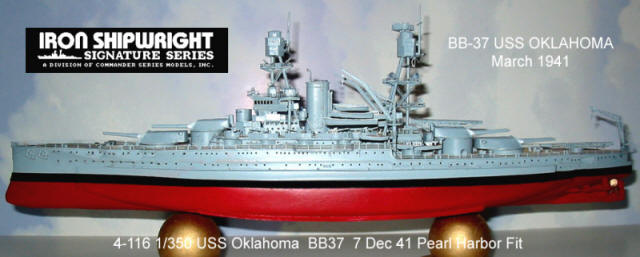
This new resin model kit of the USS Oklahoma BB-37 battleship is the full hull, 1941 Pearl Harbor fit version. Significant detail is offered with 1/350 scale.

Statistics:
Displacement: 27,500 tons
Length: 583'
Beam: 95'3"
Draft: 28'6"
Speed: 20.5 knots
Complement: 864
Armament: Ten 14" guns; twenty 5" guns; four 21" torpedo tubes
Class: Nevada
Oklahoma (BB-37) was laid down 26 October 1912 by New York Shipbuilding Corp., Camden, N.J.; launched 28 March 1914; sponsored by Miss Lorena J. Cruce, and commissioned at Philadelphia 2 May 1916, Captain Roger Welles in command.
Joining the Atlantic Fleet with Norfolk her home port, Oklahoma trained on the eastern seaboard until sailing 13 August 1918 with sister ship Nevada to join in the task of protecting Allied convoys in European waters. In December she was part of the escort as President Woodrow Wilson arrived in France, departing the 14th for New York and winter fleet exercises in Cuban waters. She returned to Brest 15 June 1919 to escort President Wilson in George Washington home from his second visit to France, returning to New York 8 July.
A part of the Atlantic Fleet for the next two years, Oklahoma was overhauled, trained, and twice voyaged to South America's west coast; early in 1921 for combined exercises with the Pacific Fleet, and later that year for the Peruvian Centennial. She then joined the Pacific Fleet for six years highlighted by the cruise of the Battle Fleet to Australia and New Zealand in 1925. Joining the Scouting Fleet in early 1927, Oklahoma continued intensive exercises during that summer's Midshipmen Cruise, voyaging to the East Coast to embark midshipmen, carrying them through the Panama Canal to San Francisco, and returning by the way of Cuba and Haiti.
Modernized at Philadelphia between September 1927 and July 1929, Oklahoma rejoined the Scouting Fleet for exercises in the Caribbean, and returned to the west coast in June 1930 for fleet operations through spring 1936. That summer she carried midshipmen on a European training cruise, visiting northern ports. The cruise was interrupted with the outbreak of civil war in Spain, as Oklahoma sped to Bilbao, arriving 24 July 1936 to rescue American citizens and other refugees, whom she carried to Gibraltar and French ports. She returned to Norfolk 11 September 1936, and to the West Coast 24 October.
Oklahoma's Pacific Fleet operations during the next four years included joint operations with the Army and the training of reservists.
She was based at Pearl Harbor from 6 December 1940 for patrols and exercises, and was moored in Battleship Row 7 December 1941 when the Japanese attacked. Outboard alongside USS Maryland (BB 46), Oklahoma took three torpedo hits almost immediately after the first Japanese bombs fell. As she began to capsize, two more torpedoes struck home, and her men were strafed as they abandoned ship. Within 20 minutes after the attack began, she had swung over until halted by her masts touching bottom, her starboard side above water, and a part of her keel clear. Many of her crew, however, remained in the fight, clambering aboard Maryland to help serve her antiaircraft batteries. Twenty officers and 395 enlisted men were either killed or missing, 32 others wounded, and many were trapped within the capsized hull, to be saved by heroic rescue efforts. Such an effort was that of Julio DeCastro, a civilian yard worker who organized the team which saved 32 Oklahoma sailors.
The difficult salvage job began in March 1943, and Oklahoma entered drydock 28 December. Decommissioning 1 September 1944, Oklahoma was stripped of guns and superstructure, and sold 5 December 1946 to Moore Drydock Co., Oakland, Calif. Oklahoma parted her tow line and sank 17 May 1947 540 miles out, bound from Pearl Harbor to San Francisco.
Oklahoma received 1 battle star for World War II service.