
Design
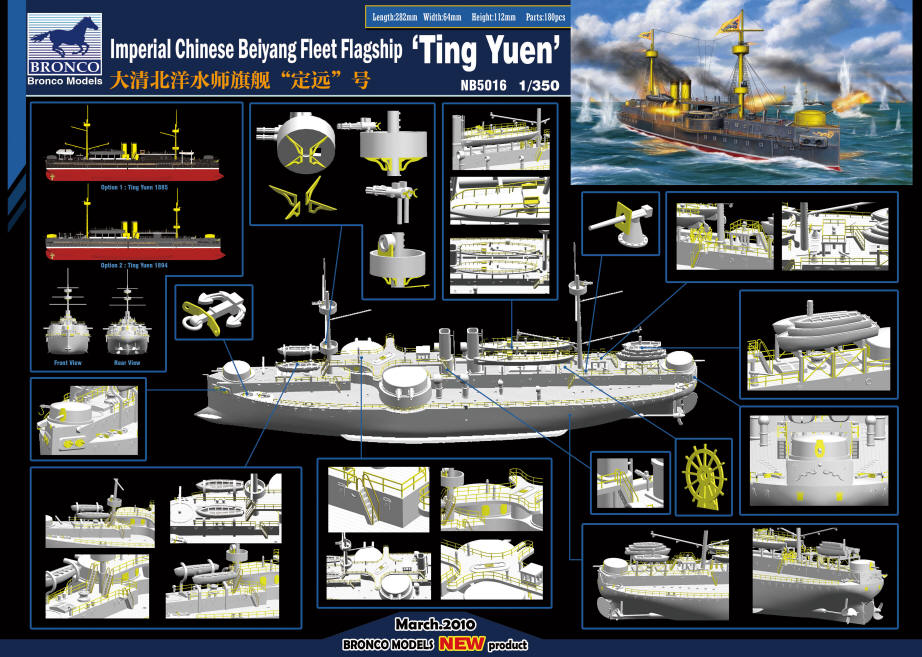
The Dingyuan was an "armoured turret ship" design. She was recognized as one of the most advanced battleships of her time, as good as or better than any ship in the fleets of Great Britain and Germany when she was built. She measured 94.5 metres long (298ft, 5in) and 18.4 metres wide (60ft, 4in) and drew 5.94 metres (19 ft, 6 in) of water. She was protected by an armoured belt 30-centimetre (1ft) thick. Experts say that the ship was resistant to the firepower available at the time.
Dingyuan , 7670 tons when loaded, had 6,000 hp (4,500 kW) and a speed of 14.5 nautical miles (27 km) per hour, and a range of around 4,500 nautical miles (8,330 km) at 10 knots (19 km/h).
Armament
The main armament was four 305 mm calibre Krupp guns in two barbettes one each to the port and starboard forward of amidships. These guns had a range of 7.8 kilometres, firing with a muzzle velocity of 500 metres per second. Another two 150 mm calibre Krupp guns were installed in turrets at the extreme bow and stern. These had a range of 11,000 metres. The armament also included six 37 mm guns and three above waterline torpedo tubes. The complete crew was around 363 officers and men.
Two torpedo boats were also carried on board, enlarging the Dingyuan's striking distance and battle effectiveness. To meet the demands on ship, 20 desalinators were installed which could serve 300 people fresh water daily.
History
After negotiations with both British and German governments, the Qing Dynasty in 1881 awarded the contract to build the advanced warship to Germany's Stettiner Maschinenbau AG Vulcan shipyard, at a cost of 1.7 million taels of silver (6.2 million German Goldmark). The hull was laid down on 31 March 1881 and she was launched on 28 December 1881 and sea trials commenced on 2 May 1883.
The delivery of the Dingyuan, sailed by a German crew, started in 1884, but was stopped following a request from the French who were in the middle of a conflict with China which culminated with the Sino-French War (1884-1885). The Dingyuan was a very powerful ship and vastly superior to any of the French ships of the French China Squadron, and should have been able to participate advantageously in the conflict, especially during the Battle of Foochow.
In 1885, the Dingyuan finally set sail for China, arriving the following year. Also in 1885, the Beiyang Fleet was founded in Weihai, and based at Liugongdao Island, marking the establishment of Qing Dynasty's first modern fleet.
By the middle of the 1890s, the waning Qing Dynasty lost its desire to keep ahead in the naval race, in contrast to the strengthening Japanese navy. Because of internal corruption, lack of funding and incompetence, by the time of the First Sino-Japanese War the Imperial Japanese Navy was able to outmaneuver the Beiyang Navy. Dingyuan served as Admiral Ding Ruchang's flagship at the Battle of the Yalu River on September 17, 1894. In that battle, due to a construction defect of the ship, the Chinese admiral Ting Ju ch'ang (Ding Ruchang) and several of his officers became casualties by their first shot, standing in the flybridge. After this, the Beiyang Fleet was based at Liugongdao Island. In early 1895, the Japanese surrounded the Beiyang Fleet both on land and from the sea. On February 5, 1895, the Dingyuan was seriously damaged after being hit by a Japanese torpedo and later cannon fire. Captain Liu Buchan ordered the ship scuttled.
